Author: Julia Finley Mosca
Genre: Children’s Biography / STEM / Neurodiversity
“The most interesting people you’ll find are ones that don’t fit into your average cardboard box. They’ll make what they need, they’ll make their own boxes.”
-Dr. Temple Grandin
A new month means a new series of blog posts. April aims to celebrate neurodiversity and strive to increase understanding and acceptance of neurodivergence. Neurodivergence implies that some people have a different way of thinking, learning, and experiencing the world. Autism, ADHD (Attention-Deficit/Hyperactivity Disorder), dyslexia (difficulty with reading), dyspraxia (difficulty with coordination), and Tourette’s syndrome (tics), are some examples of neurodivergence. Though they might have a different way of interpreting the world around them, they do have unique talents and perspectives. Like for instance , an individual with autism has incredible focus and attention to detail or a person with dyslexia may have brilliant visualization skills.
But societal norms and expectations can sometimes create challenges for neurodivergent individuals. This is why the neurodiversity movement advocates for making the world more inclusive and understanding. So, through my blogs this month, I try to delve into their world through different media of expression. By undertaking this, I do hope that I am able to raise an awareness about the same and hope that we can create a more inclusive and understanding world for such people.
This week’s pick talks about a young girl who was once misunderstood, labelled and excluded but later on brought a change in the world through her actions. How ? Read on to find out more.
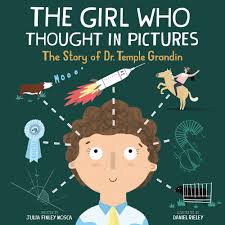
Synopsis: The Girl Who Thought In Pictures narrates the story of Dr. Temple Grandin who was a pioneering scientist and an advocate for autism. This book written by Julia Finley Mosca brings to life the incredible journey of a young girl who went on to revolutionize the world of animal science.
Temple was born in a time when autism wasn’t well understood. People thought she was different as she didn’t speak until she was nearly four, and processed the world in pictures rather than words. But there was one person who believed in her and that was her mother. Her mother’s steady belief in her and her own thinking helped her to transform her so-called “different” brain into a superpower. The book captures how Temple learned to embrace her strengths and become a prominent name in the field of science and technology.
Analysis: This book tries to give out a powerful message of how neurodiversity when channeled positively helps to solve problems which others can’t see. It also conveys a message that being different is not a weakness, but a strength. The rhythmic writing of the author makes it an ideal book for reading out aloud. Although the book is written in a poetic structure, it still addresses the challenges Temple faced . In a world where everyone is supposed to act in a certain manner at a certain age and perceive the world in the same manner as others, this book attempts to celebrate authenticity, resilience and brain diversity. It acts as a great guide for educators, parents and for anyone who has ever felt different. After all, isn’t life all about embracing your authentic self rather than fitting into the mould that the world designs for you?
Verdict: This book is more than a biography — it’s a celebration of thinking differently, loving fiercely, and daring to break the mold. The book is a powerful conversation starter as it simplifies a complex, misunderstood subject like autism . It also helps children to understand that their differences can be their greatest strengths.
From an educational standpoint, the book ticks all the right boxes. Teachers and parents can use it as a medium to discuss topics like neurodiversity, empathy, perseverance and scientific discovery. While for kids who struggle with the feeling of being different, the story of Temple Gardin can serve as an inspiration for not only overcoming obstacles but also for what she contributed to the world.
This is a book that should be a part of every classroom, every library, and every home. It acts as an invitation to see the world through new eyes — eyes that may think in pictures, patterns, or possibilities. Whether you’re a parent, teacher, or simply a fan of stories that uplift and educate, The Girl Who Thought in Pictures is a must-have in your collection.
Rating: ****
Cite Bite: “Each person is special — so UNIQUE are our minds. This world needs your ideas. It takes brains of ALL kinds!”
Que : Which invention of Dr. Temple Gardin is still in use?
a. Milking machine
b. Artificial Insemination
c. Automatic Feeding Systems
d. Cattle Corral

 The Expression Hub
Leave a comment