Author: Robert Coles
Genre:Biography
“Courage isn’t having the strength to go on – it is going on when you don’t have the strength.”
-Napolean Bonaparte
Courage is a trait that makes other virtues possible. It is that trait which allows us to face any type of danger, pain, uncertainty, or intimidation. It acts as a catalyst for change and progress in personal life and society. It helps individuals to pursue difficult but meaningful goals. It is the vital inner strength that enables us to live authentically and fulfil our true potential.
This month, I raise my glass not just to the thunderous, visible acts of heroism, but to the quiet, daily, and often unseen acts of courage.To the courage to dream and the courage to start. To the courage to fight the good fight and the courage to forgive. To the courage to stand up, and the courage to simply show up, even when it’s hard. May we all find the strength to choose action over fear, and may the courage of others light our own path forward.
This week features a powerful story. It’s about a young girl. Her single act caused a huge societal change. She was not a professional activist. Her quiet courage made her a catalyst of history. Who was she? What did she do? Her story still inspires us today. Read on to uncover the remarkable details.
About the Book:On November 14, 1960, a small six-year-old girl in a crisp white dress walked up the steps of William Frantz Elementary School in New Orleans, Louisiana. She was escorted by four federal marshals. She became the first African American child to desegregate an all-white elementary school in the South. This single act of courage, carried out by a first-grader, would become one of the most iconic moments of the Civil Rights Movement.
The story of Ruby Bridges is not just a historical footnote—it’s a testament to extraordinary courage in the face of hatred, the power of innocence to challenge injustice, and the profound impact one person can have on the course of history, regardless of their age.
The doctrine of “separate but equal” had been the law of the land since the 1896 Plessy v. Ferguson Supreme Court decision, creating a system of legal segregation that permeated every aspect of Southern life. But this all changed when the landmark Brown v. Board of Education decision in 1954 declared school segregation unconstitutional. But what was unconstituional in paper was still practiced in real life. This was prominent in the Southern states of the United States of America . They resisted desegregation so fiercely, that some districts closed public schools entirely rather than integrate.
But this was challenged by Ruby as she was one of only six African American students who passed the test. This was a testament to her intelligence and her mother’s dedication to her education.
What happened next and what steps Ruby took forms the remainder of the story that made her an example of courage .
Analysis: Ruby Bridges’ story reveals several profound truths about social change and human nature. First, it demonstrates that courage is not the absence of fear, but action in spite of it. Ruby was terrified—she had nightmares, she stopped eating—but she continued to show up.
Second, her story highlights the critical role of support systems. Ruby didn’t act alone. Her mother’s determination, Mrs. Henry’s commitment, the federal marshals’ protection, and Dr. Coles’ counseling all contributed to her ability to endure. Social change requires individual courage, but it also requires community support.
Third, Ruby’s experience exposes the absurdity and cruelty of racism. Sometimes the most powerful advocacy is simply showing up and being yourself.
Finally, Ruby’s story illustrates the long arc of progress. Change didn’t happen overnight. It was uncomfortable, painful, and met with fierce resistance. But by maintaining her dignity and humanity in the face of dehumanization, Ruby helped bend that arc toward justice.
She later grew up to Ruby Bridges’ story reveals several profound truths about social change and human nature. First, it demonstrates that courage is not the absence of fear, but action in spite of it. Ruby was terrified—she had nightmares, she stopped eating—but she continued to show up. Her daily walk to school was an act of defiance against an unjust system.
Second, her story highlights the critical role of support systems. Ruby didn’t act alone. Her mother’s determination, Mrs. Henry’s commitment, the federal marshals’ protection, and Dr. Coles’ counseling all contributed to her ability to endure. Social change requires individual courage, but it also requires community support.
Third, Ruby’s experience exposes the absurdity and cruelty of racism. The sight of adults screaming hatred at a six-year-old child, threatening her life over the color of her skin, revealed the moral bankruptcy of segregation in a way that no amount of legal argument could. Sometimes the most powerful advocacy is simply showing up and being yourself.
Finally, Ruby’s story illustrates the long arc of progress. Change didn’t happen overnight. It was uncomfortable, painful, and met with fierce resistance. But by maintaining her dignity and humanity in the face of dehumanization, Ruby helped bend that arc toward justice.
She grew up to become an activist, author, and public speaker. She established the Ruby Bridges Foundation in 1999 to promote tolerance and unity. Even though she achieved something remarkable by her act, she remains humble about the same.
She just feels that she was supported by people who believed in something larger than themselves.
Verdict: The story of Ruby Bridges reminds us that that progress requires sacrifice, that change is possible even in the face of overwhelming opposition, and that sometimes the most revolutionary act is simply insisting on your humanity and your rights.
Her story also serves as a mirror, reflecting both the best and worst of American society. The hatred she faced was real and systemic, but so was the courage of those who supported her—her family, Mrs. Henry, the federal government officials who enforced the law, and eventually, the community members who chose integration over fear.
Ruby Bridge’s courage helped dismantle a system of oppression and paved the way for generations of children to receive an equal education. Her story continues to inspire anyone fighting for justice, proving that you’re never too small, too young, or too powerless to make a difference.
It prompts us to ask a question :What will we do today, in the face of injustice we witness in our own time? And most importantly it addresses an issue
Rating: *** and 1/2 stars
Cite Bite: “Racism is a grown-up disease, and we must stop using our children to spread it.“
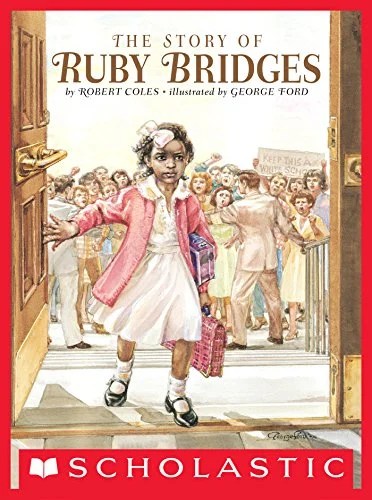
Que: What did Ruby do everyday as she walked down the school?
a. Nibbled at nuts
b. Shouted at the adults back
c. Prayed for their welfare
d. Waved at the adults
Ruby’s courage deserves to be amplified. Share this article and help us reach:
Young people who wonder if their voice matters
Parents teaching their children about equality
Educators looking for powerful teaching moments
Anyone who needs a reminder that one person can make a difference

 The Expression Hub
Leave a comment