• Since it is Neurodiversity Celebration Month, it is high time that we try to understand what exactly neurodivergence is. Also, while understanding what neurodivergence is, we also try to understand what are the strengths of people with neurodivergent minds , how their mind functions while navigating the world around them and how schools and workplaces can be made inclusive. So, lets dive in.

    What is neurodivergence?

    Neurodivergence refers to a variation in the functioning of the mind that leads to different ways of thinking, learning, processing information and experiencing the world. Rather than viewing it as a deficit, the people who are advocates of the neurodiversity movement encourage us to view them as valid, natural variations in human cognition.

    Neurodivergent individuals are individuals with autism, ADHD, dyslexia, dyspraxia, dyscalculia, Tourette’s Syndrome and other neurological differences. This diversity does not represent a collection of disorders but rather an amalgamation of human neurological variation.

    What does it mean to be a neurodivergent individual?

    A neurodivergent individual experiences the world with a heightened intensity like for instance colours may seem brighter, sounds may be louder, more overwhelming emotions and many such patterns.

    Social interactions often are a major challenge for such individuals not because they do not want to feel connected but due to differences in communication styles. They interact differently , require more direct communication or become easily overwhelmed in social settings that normal human beings navigate with great ease.

    Cognitive processes that help us to plan, focus, remember instructions and manage multiple tasks are challenging for such individuals. Such tasks are easier for a normal human being . However, tasks which may seem complex are solved with great insight and creativity by such individuals.

    What are the hidden strengths of neurodivergent individuals?

    Though these individuals interpret the world differently, but many neurodivergent individuals possess an exceptional ability to hyperfocus on areas of interest diving deeply into subjects and developing expertise. This level of intense focus can make them exceptional at innovation and creative problem-solving.

    They are also good at identifying patterns in data, systems or ideas that others might miss. This leads to unique perspectives and innovative solutions. Many great individuals like Albert Einstein, Temple Grandin, Alan Turing used their this type of thinking and created a revolution in their fields.

    What are the challenges faced by neurodivergent individuals?

    Neurodivergent individuals even so being exceptionally talented face a lot of challenges while navigating the world which is made for neurotypical minds. Differences in sensory processing can make everyday environments overwhelming. Too much of light, noise or other sensory stimuli can stimulate a sensory overload which makes concentrating on a task difficult.

    Social expectations like unwritten rules, indirect communication and ambiguous social cues can feel like navigating a foreign land without a translation guide. To combat this, masking behaviors are developed by these individuals. These behaviors though help them adopt manners like normal human beings but leads to exhaustion and burnout.

    Cognitive processes can make simple tasks like organizing a workspace, managing time or chunking of bigger tasks are difficult for such individuals. These struggles are often labelled as laziness or incompetence when they actually reflect differences in the functioning of the brain.

    Connection between neurodivergence and mental health

    Chronic stress from too much sensory overload, masking, executive functioning and difficulties in social interactions can lead to anxiety and depression in such individuals.

    Also, many neurodivergent individuals face years of misdiagnosis, inappropriate treatments, or no support at all before receiving an accurate understanding of their neurotype. This often leads to internalized shame, imposter syndrome, and a distorted self-image.

    Mental health support for neurodivergent individuals is most effective when it acknowledges neurodivergence as a difference and works with rather than against neurodivergent traits. Therapy approaches that respect sensory needs, communication differences, and executive functioning challenges tend to be most beneficial.

    How do we go on to create an inclusive environment at work and in schools?

    Standardized teaching methods, curricula which is inflexible, and environments which are sensory-heavy can make learning difficult despite strong cognitive abilities for people with neurodivergence. Similarly, conventional workplace expectations around eye contact, multitasking, open-plan offices, and unstructured social interaction can create unnecessary obstacles to success for such people.

    So, to create effective educational approaches, the following can be considered-

    1. Have multiple means to engage, represent and express.
    2. Build strengths in areas of interest and ability.
    3. Give clear instructions.
    4. Ensure that environments are sensory-friendly with options for regulation.
    5. Recognize and accommodate differences in executive functioning.

    In the workplace, create environments where neurodivergent individuals can thrive by-

    1. Giving clear instructions about what is expected from them.
    2. Allowing flexibility in how tasks are to be accomplished.
    3. Creating environments which are sensory-friendly.
    4. Being result-oriented rather than conforming to the norms of the society.
    5. Recognizing and utilizing the unique perspectives such individuals bring.

    Organizations that are working on this are recognizing the fact that neurodiversity in the workplace is leading to innovation, problems being solved in a creative manner and creation of systems that work for everyone.

    How do we bridge the communication gap ?

    Neurodivergent individuals often face challenges concerning communication. They may interpret language more literally, or may struggle with implied meanings, or may communicate in ways that maybe too blunt or detailed for normal listeners. But these differences aren’t deficits. Instead, they’re simply variations in how human brains process and express information.

    So, to overcome this, neurotypical individuals can learn to be more direct, specific, and explicit in their communication, while neurodivergent individuals can develop strategies to navigate the implicit communication styles thus creating a middle ground where meaningful exchange can occur.

    How to make a neurodivergent individual feel safe in a relationship or in a community?

    Just like other human beings,neurodivergent individuals too desire and form meaningful relationships, though these connections may look different from neurotypical norms. These relationships often thrive on mutual understanding, explicit communication, shared interests, and respect for neurodivergent traits like the need for alone time, sensory considerations, and different expressions of affection. This can be implemented by finding community with others who share similar neurotypes. This can offer opportunities to be fully authentic without masking, to share coping strategies, and to celebrate neurodivergent strengths in an affirming environment.

    Way ahead

    As our understanding of neurodivergence continues to evolve, so too does our collective responsibility to create a world that embraces neurological diversity. This can be done in the following manner-

    1. Design spaces, systems, and interactions that work for all neurotypes from the beginning.
    2. Ensure conversations about neurodivergence .
    3. Appreciate the perspective put forward by neurodivergent individuals.
    4. Understand how neurodivergence intersects with race, gender, sexuality, and other aspects of identity to create unique experiences.
    5. Actively seek out and value the unique contributions neurodivergent minds bring to our communities.

    The path toward true inclusion isn’t simply about tolerance or accommodation—it’s about creating a world where neurodivergent individuals can fully participate, contribute their unique perspectives, and thrive as their authentic selves. This is what the neurodiversity movement reminds us that there is no single “right” way to think, learn, or perceive the world. But by accepting the full range of human cognition, we create stronger communities, more innovative solutions, and a more just and inclusive society for everyone.

    It is not our differences that divide us. It is our inability to recognize, accept, and celebrate those differences.” -Audre Lorde

    Continue reading →: Let’s understand neurodivergence
  • Author: Julia Finley Mosca

    Genre: Children’s Biography / STEM / Neurodiversity

    “The most interesting people you’ll find are ones that don’t fit into your average cardboard box. They’ll make what they need, they’ll make their own boxes.”

    -Dr. Temple Grandin

    A new month means a new series of blog posts. April aims to celebrate neurodiversity and strive to increase understanding and acceptance of neurodivergence. Neurodivergence implies that some people have a different way of thinking, learning, and experiencing the world. Autism, ADHD (Attention-Deficit/Hyperactivity Disorder), dyslexia (difficulty with reading), dyspraxia (difficulty with coordination), and Tourette’s syndrome (tics), are some examples of neurodivergence. Though they might have a different way of interpreting the world around them, they do have unique talents and perspectives. Like for instance , an individual with autism has incredible focus and attention to detail or a person with dyslexia may have brilliant visualization skills.

    But societal norms and expectations can sometimes create challenges for neurodivergent individuals. This is why the neurodiversity movement advocates for making the world more inclusive and understanding. So, through my blogs this month, I try to delve into their world through different media of expression. By undertaking this, I do hope that I am able to raise an awareness about the same and hope that we can create a more inclusive and understanding world for such people.

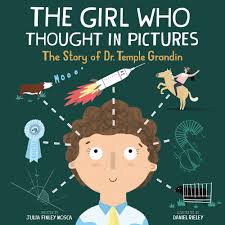
    This week’s pick talks about a young girl who was once misunderstood, labelled and excluded but later on brought a change in the world through her actions. How ? Read on to find out more.

    Synopsis: The Girl Who Thought In Pictures narrates the story of Dr. Temple Grandin who was a pioneering scientist and an advocate for autism. This book written by Julia Finley Mosca brings to life the incredible journey of a young girl who went on to revolutionize the world of animal science.

    Temple was born in a time when autism wasn’t well understood. People thought she was different as she didn’t speak until she was nearly four, and processed the world in pictures rather than words. But there was one person who believed in her and that was her mother. Her mother’s steady belief in her and her own thinking helped her to transform her so-called “different” brain into a superpower. The book captures how Temple learned to embrace her strengths and become a prominent name in the field of science and technology.

    Analysis: This book tries to give out a powerful message of how neurodiversity when channeled positively helps to solve problems which others can’t see. It also conveys a message that being different is not a weakness, but a strength. The rhythmic writing of the author makes it an ideal book for reading out aloud. Although the book is written in a poetic structure, it still addresses the challenges Temple faced . In a world where everyone is supposed to act in a certain manner at a certain age and perceive the world in the same manner as others, this book attempts to celebrate authenticity, resilience and brain diversity. It acts as a great guide for educators, parents and for anyone who has ever felt different. After all, isn’t life all about embracing your authentic self rather than fitting into the mould that the world designs for you?

    Verdict: This book is more than a biography — it’s a celebration of thinking differently, loving fiercely, and daring to break the mold. The book is a powerful conversation starter as it simplifies a complex, misunderstood subject like autism . It also helps children to understand that their differences can be their greatest strengths.

    From an educational standpoint, the book ticks all the right boxes. Teachers and parents can use it as a medium to discuss topics like neurodiversity, empathy, perseverance and scientific discovery. While for kids who struggle with the feeling of being different, the story of Temple Gardin can serve as an inspiration for not only overcoming obstacles but also for what she contributed to the world.

    This is a book that should be a part of every classroom, every library, and every home. It acts as an invitation to see the world through new eyes — eyes that may think in pictures, patterns, or possibilities. Whether you’re a parent, teacher, or simply a fan of stories that uplift and educate, The Girl Who Thought in Pictures is a must-have in your collection.

    Rating: ****

    Cite Bite: “Each person is special — so UNIQUE are our minds. This world needs your ideas. It takes brains of ALL kinds!”

    Que : Which invention of Dr. Temple Gardin is still in use?

    a. Milking machine

    b. Artificial Insemination

    c. Automatic Feeding Systems

    d. Cattle Corral

    Continue reading →: Steering the world through pictures
  • Author: Alex and Brett Harris

    Genre: Self-help/ Young adult

    “Age is no excuse to postpone your calling.”

    When we hear the word “teenager,” what do we associate it with? The picture that often comes into our mind is that of rebellious kids, kids who have a lot of energy, kids who are going through puberty changes, kids who are discovering new things about themselves, and a lot more. We often feel that they are not mature enough to take on the challenges of life as they do not possess the required skill set or abilities which will help them overcome the obstacles in the way a mature adult can overcome with the help of his or her thinking. However, one book begs to differ on this opinion. It feels that teenagers are as much as capable as adults when it comes to taking responsibility. Which book talks about this interesting take ? Lets explore.

    About the book: Do Hard Things: A Teenage Rebellion Against Low Expectation by Alex and Brett Harris is a book that challenges the modern notion of adolescence and encourages young people to embrace responsibility, hard work, and meaningful challenges during their teenage years. The twin brothers were 19 years old when they wrote this book. They started a blog which was supposed to be a movement to inspire young people to rebel against the low expectations society places on them.

    The book says that modern culture has artificially lowered expectations for teenagers. It has created a self-fulfilling prophecy where young people meet only the minimal standards set for them. However, the authors feel that capability isn’t determined by age. They provide historical examples of teenagers throughout history who accomplished remarkable feats – from Alexander the Great leading armies at age sixteen to Clara Barton teaching school at age fifteen .

    They write that teenagers should undertake five types of hard things which are as follows:

    1. Things which are outside their comfort zone– This helps to stretch one’s abilities and forces a person to grow.
    2. Things that go beyond what’s expected– This will enable one to pursue a path of excellence.
    3. Things that are too big to accomplish alone: This builds a spirit of teamwork and cooperation.
    4. Things that don’t pay off immediately: This helps to build character, helps to master the art of delayed gratification and seek future rewards.
    5. Things that challenge the cultural norm: Peer pressure is a norm while growing up. By challenging the cultural norm, one makes a conscious effort as regards to what needs to be undertaken as regards to media consumption, relationships, and personal conduct.

    However, the central argument of the book is that tackling difficult challenges forms character in ways that comfort and ease cannot. The Harris brothers draw on both psychological research and biblical principles to argue that perseverance through difficulty builds resilience, confidence, and moral strength. They contrast this approach with what they call “the comfort cult” – our society’s tendency to prioritize ease and pleasure above growth and purpose.

    Analysis: “Do Hard Things” effectively blends personal stories, historical examples, and biblical principles to make its case. The Harris brothers draw from their own experiences when they organized political campaigns, spoke at conferences, and built an online community to demonstrate what teenagers can accomplish when challenged.

    The book offers specific strategies and real-world examples of teenagers doing remarkable things. At the end of each chapter, thought-provoking questions and steps which will make the process of taking action simpler is provided to the readers.

    The authors’ writing style is accessible and engaging, strategically using humor and personal anecdotes to maintain reader interest while addressing substantive topics. Their first-hand experience as teenagers tackling significant challenges lends credibility to their message.

    The book’s Christian perspective tries to provide an ethical foundation, but this framing tends to limit its appeal to secular readers. This is because the core principles discussed are broadly applicable irrespective of their religion. Also, the frequent biblical references and faith-based motivations may not resonate with all audiences.

    There might also be some aversion to the fact that the book places heavy emphasis on achievement and external accomplishments. This may potentially create pressure for already-stressed teenagers and create a scenario of unfair comparisons.

    Despite the limitations, the book has inspired countless teenagers to launch projects, businesses, ministries, and initiatives that serve others and develop their own capabilities. This has helped to explore the untapped areas of character development and youth potential.

    Verdict: “Do Hard Things” presents a compelling vision for teenage potential that stands in stark contrast to much of contemporary youth culture. Its core message about the value of challenge, responsibility, and meaningful work resonates regardless of religious background.

    It offers a refreshing alternative to the typical messaging aimed at their demographic. For parents and educators, it provides a framework for encouraging teenage excellence without micromanaging.

    In a culture that often celebrates ease and comfort, “Do Hard Things” makes a persuasive case that true fulfillment comes through embracing challenges that matter.

    The book though written in 2008, continues to be relevant even today. This is because it challenges the notion that the teenage years should be merely a time of leisure and minimal responsibility. By encouraging young people to tackle meaningful challenges, the Harris brothers have created a manifesto for teenage potential that has inspired countless readers to reject complacency and pursue excellence.

    Cite Bite: “Complacency is a deadly foe of all spiritual growth.”

    Que : What was the name of the blog the teen brothers started?

    a. The Revolution

    b. The Rebellution

    c. The Rebels

    d. The Misfits

    Continue reading →: The secret to success?Do hard things

I’m Roshani

Welcome to The Expression Hub! I’m Roshani, who loves to express herself through the medium of writing. This blog is my little corner of the internet where I dive deep into the world of movies, books, and web series—reviewing, analyzing, and sometimes just ranting about the stories that make us laugh, cry, and question everything.

Beyond reviews, you’ll also find my personal musings—random thoughts, life reflections, and the occasional deep dive into the things that inspire me. Think of this as a space where art meets emotion, and where honest opinions matter more than star ratings.

Join me as we explore incredible stories together, one post at a time. Have a recommendation? Let’s talk—I’m always up for discovering something new!

Let’s connect

Design a site like this with WordPress.com
Get started